Spine Basics
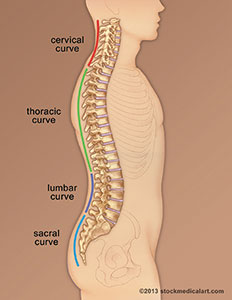
Your spine does a lot of work! It holds up your head, shoulders, and upper body. It supports you so you can stand up, but also helps you bend and twist. It also protects the spinal cord. Your spine has four main curves that help you keep your balance and stand straight. The lowest part of the spine connects to the sacrum, a bone that fits between the two hip bones.
The spine is made of bones (vertebrae) that are stacked on top of each other with disks (intervertebral disks) in between them. When you walk or run, the disks act like a cushion and keep the bones from bumping into each other. The vertebrae attach to each other with joints and ligaments. This allows your spine to rotate, and bend backward, forward, and side to side. Muscles, tendons and ligaments support your back and help you move. Nerves carry messages between your brain and your muscles.
Causes of Pain
Some likely reasons of neck and upper back pain are:
- Strained muscles
- Sprained ligaments
- Tight or locked joints
- Small tears in the disks
Whatever the cause, neck and upper back pain is usually treated the same way: keep moving but limit repetitive body movements, by alternating tasks, take occasional breaks as needed, apply ice (or heat if ice doesn’t help), and take non-prescription pain relievers if necessary and approved by your doctor.
Call your doctor right away if you have:
- Weakness, numbness, or tingling in your arms or legs
- Constant or intense pain
- Had an injury to your neck or upper back
- Pain with associated ringing of the ear, double vision or difficulty in swallowing.
Fortunately, you can reduce your risk of neck or upper back pain and improve your overall health. You have the power to change some back pain risk factors
80%
At some point, 80% of uswill have low back pain. Most people (about 90%) recover fully within 6 weeks.