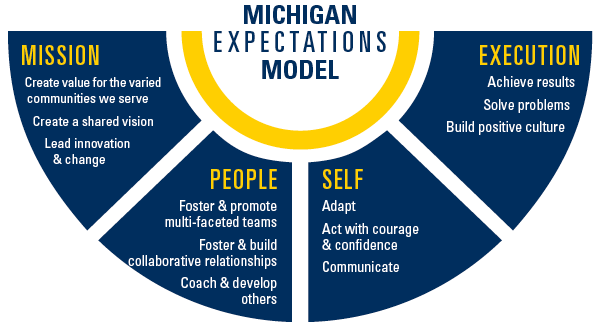
The Michigan Expectations Model (MEM) identifies 12 benchmark behavioral standards that all university faculty and staff should demonstrate. The goals of the MEM are to support our shared mission and equip faculty and staff with an understanding of the behavioral expectations needed for success at the University of Michigan.
These behavior standards, termed expectations, will be referenced and used in a variety of ways, including customer care, hiring, professional development and daily conduct.
The model is a framework for development and performance management. It is organized into four domains, each with a set of three related expectations:
Mission
We demonstrate institutional responsibility placing U-M goals as primary. We speak openly and with conviction about our guiding vision and values. We put those whom we serve (staff, faculty, learners, families, etc.) first, leading change to promote equity and inclusion for all.
Create value for the varied communities we serve
We foster a climate of service excellence, engaging staff, faculty and students.
Create a shared vision
We build consensus around a shared vision.
Lead innovation and change
We catalyze change by recognizing its need, challenging the status quo, energizing stakeholders and those we serve, and championing experiments to improve.
People
We engage people to evoke excellence in all we do. We encourage people to practice healthy behaviors. Our leaders build leaders. Our leaders build teams with common goals and interdependencies. Some leaders recruit, select, train, develop and manage people.
Foster and promote multi-faceted teams
We build trusting relationships with team members through respectful and thoughtful interactions
Foster and build collaborative relationships
We generate an atmosphere of collegiality and are models of respect, helpfulness, inclusivity and cooperation, creating internal and external networks.
Coach and develop others
We are adept at cultivating people's abilities and have a genuine interest in helping them develop professionally and personally.
Self
We strive to be emotionally intelligent. We practice self-reflection. We are aware of our guiding values and our biases. We assume we do not know the best course of action. We can break down a complex situation into manageable chunks. We model healthy behaviors.
Adapt
We are self-aware; we seek to resolve multiple demands, adapt to new challenges, adjust to fluid change and are limber in our thinking in the face of new data or realities.
Act with courage and confidence
We seize opportunities, welcome and share challenging assignments and integrate present realities and future possibilities.
Communicate
We encourage the open expression of ideas and opinions, and serve as role models in actively listening.
Execution
We are strong in achievement and practice what we teach. We ask questions to understand the situation or problem. We plan experiments to achieve results based on root causes. We check our work and adjust regularly. The “how” is as important as the “what” and “why”.
Achieve results
We have high personal standards and achieve exceptional improvements through the development of multi-faceted teams focused on a common vision and goals.
Solve problems
We identify and solve problems through analysis based on first hand observation.
Build positive culture
We are politically and organizationally astute, understanding internal and external forces that affect the organization.
Expectations and Behaviors
Each faculty and staff member is expected to apply the skills, principles and behaviors of the Michigan Expectations Model and demonstrate personal leadership and responsibility.
Given the diverse nature of our work, this framework can be adapted for the unique needs of any unit, department or school. An individual's development path will vary depending on their current state of acquired skills, experience and breadth of responsibility.
The model is further broken down by behaviors for each of the following employee roles:
- Member of a Team (responsible for the delivery of services to your stakeholders often in partnership with others)
- Leading a Team (coordination of the efforts of others in the delivery of services and mission-related activities to stakeholders)
- Leading Multiple Teams (responsible for the direct implementation of strategies that support organizational goals and mission-related activities)
- Leading the Organization (set organizational direction and have responsibility for management and stewardship of the organization)
The behaviors within each role build upon each other as one moves up within the organization. For example, someone in the Leading Multiple Teams role should be proficient in behaviors for the Member of a Team and Leading a Team roles in addition to those in the Leading Multiple Teams role.