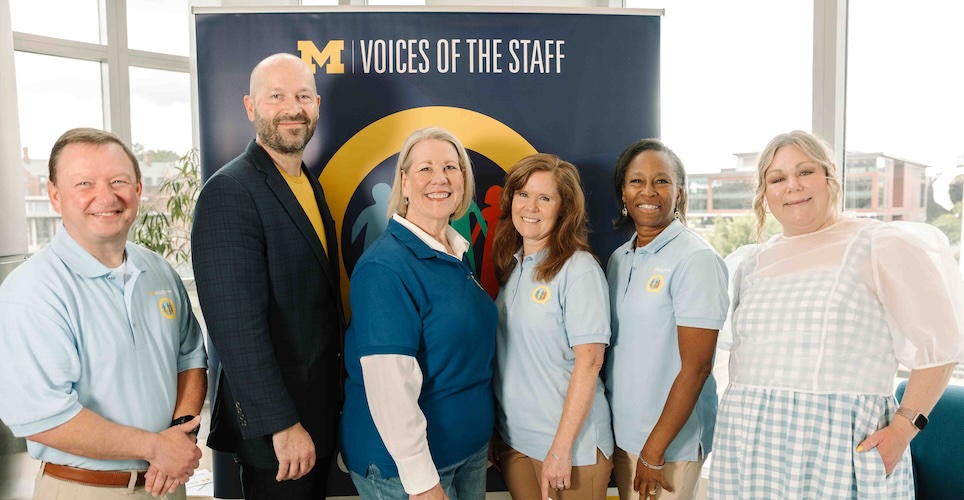
See photos from the June 2026 Voices Annual Meeting in this Dropbox folder.
Bringing together more than 200 Voices of the Staff members, program alumni, and university leaders, the annual Voices of the Staff meeting at Palmer Commons celebrated 21 years of grassroots, staff-driven impact at the University of Michigan. Reflecting a true cross-section of the university, network members from every campus and Michigan Medicine participated.
Special guests from executive leadership also attended the event to show their direct support for the staff members' ongoing advocacy and efforts. Centered on the timely theme, "Voices to Vision: Advancing What’s Possible at Michigan," the day-long event held in June focused heavily on how frontline employee perspectives will shape the changing landscape of higher education, workplace culture, and emerging technology.
Aligning with "Look to Michigan"
A presentation by Amy Homkes-Hayes illustrated how the collective efforts of the Voices network directly intersect with Look to Michigan, the university's overarching strategic commitments, as well as upcoming U-M Theme Years. Homkes-Hayes noted that high-level institutional visions cannot succeed in a vacuum; they require the practical, day-to-day insights of frontline staff to truly inform and guide university policy effectively.
Shaping a Human-Centered AI Future
A major highlight of the morning session was a deep-dive presentation on artificial intelligence led by Cathy Handyside and Bob Jones from Information Technology Services (ITS). As generative tools increasingly integrate into daily university workflows, Handyside and Jones emphasized how U-M is uniquely positioned to model a moral, ethical, and human-centered approach to technology.
Rather than viewing automation as a replacement for human capability, the speakers framed AI as a collaborative tool to reduce administrative burdens, freeing up staff to focus on high-impact, creative work. The session underscored that the success of these technological rollouts relies entirely on the continuous feedback and adaptiveness of the university’s diverse workforce.
Celebrating a Growing Legacy
Throughout the day, the energy of the network was on full display as all seven Voices Network teams presented their annual project posters, highlighting grass-roots solutions for workplace improvements, talent retention, and professional development. The gathering also served as a passing of the torch, formally welcoming the incoming 2026–2027 cohort while celebrating outgoing members as they officially transitioned into the program’s active alumni network.
Reflecting on the milestone event and the decades of progress behind it, Dyan Jenkins Ali, Assistant Director of Voices of the Staff, summarized the true power of the initiative:
"Voices of the Staff is the vital connective tissue between frontline experience and university leadership. For over two decades, this program has proved that when we intentionally listen to our staff, we don’t just improve individual workplaces—we actively shape the strategic vision and future of the entire University of Michigan."
As the program marched into its third decade, the Voices to Vision meeting offered a key takeaway: at Michigan, the staff perspective isn't just an asset—it is the blueprint for advancing what is possible.