Skip to main content
Ergonomics Grants
Questions and Answers
- What are Ergonomics Grants?
- Ergonomics Grants are funds that provide seed money for U-M departments or units to purchase equipment or redesign work processes for projects that solve high-risk ergonomic issues that affect groups of U-M faculty and staff.
- What is the goal of Ergonomics Grants?
- The goal of Ergonomics Grants is to reduce ergonomic risk factors to help improve faculty and staff comfort, safety, productivity and job satisfaction.
- What kind of projects will be considered for Ergonomics Grants?
- The competitive Ergonomics Grants can fund projects that affect groups of U-M faculty and staff. Grants are for projects not yet funded or completed by other resources.
- See examples of projects funded with Ergonomics Grants.
- Qualifying projects must address one or more of the following ergonomic risk factors:
- Awkward Postures - Posture is the position the body... Awkward postures include reaching, twisting, bending, kneeling, squatting, working overhead with your hands or arms, or holding fixed positions.
- Forceful Exertions - Force is the amount of physical effort required to perform a task, like heavy lifting or controlling equipment or tools. The amount of force depends on the type of grip, the weight of an object, body postures, the types of activity and the duration of the task.
- Repetition or Sustained Postures - Repetition and sustained postures are either doing the same motions over and over again or holding the body in one posture for long periods of time. Both place stress on the muscles and tendons.
- Contact Stress - Contact stress is pressing the body against a hard or sharp surface. It can put too much pressure on nerves, tendons, and blood vessels. For example, using your hand as a hammer can increase your risk of Injury.
- Vibration - Vibration occurs while using tools such as sanders, grinders, chippers, routers, drills and saws. Too much vibration can lead to nerve and blood vessel damage. Special padding or anti-vibration gloves can help.
- Temperature Extremes - Temperature extremes are too high or too low for the worker's health and productivity.
- What kind of projects will not be considered for Ergonomics Grants?
- Projects for individuals, nor non-ergonomic issues
- U-M non-ergonomics safety issues, such as lead paint removal, wiring/heating/cooling, or infection control measures.
- Small office items such as keyboards, mice, footrests, etc.
- Treadmill workstations, ball chairs
- Projects for students, external companies
- Shipping, handling, installation labor costs
- Items already purchased. The grants are to help fund needed projects without sufficient other resources.
- Sit/stand workstations are not typically funded. Instead we encourage all faculty and staff to walk or move more, however they can, throughout the work day.
- Individual prevention needs at U-M; we encourage the department to fund those items. For help with individual faculty or staff who are under a doctor's care for an ergonomic or disability issue, please contact MHealthy medical ergonomics.
- U-M large scale department redesign (e.g. cubicles, desks, file cabinets)
- How much funding is provided by Ergonomics Grants?
- Proposals may be funded for up to $5,000 per grant, with departmental cost sharing highly recommended. Funded departments need to make the full purchase, and then the Grant funds will be provided when proof of purchase is received.
- Does applying guarantee funding?
- No, due to the large number of requests received, not all projects can receive funding. In order to spread the benefits throughout the university, grants usually vary from one hundred to a few thousand dollars per project. To help those in greatest need, apply only if the department does not have other ways to fund the project.
- Who reviews the proposals and can help with questions?
- Proposals will be reviewed by the MHealthy Ergonomics Awareness Team, consisting of ergonomic consultants and health and safety personnel from Environment, Health and Safety Offices in Dearborn, Flint, MHealthy, EHS Ann Arbor and UMHHC Safety Management Services.
- For questions about your project please contact your local ergonomics injury prevention representative. Their information can be found on the How to Get Help page.
- For questions regarding submitting an application please email [email protected] or call (734) 647-7888.
- Be sure to include your department supervisor or manager in your project planning. The Ergonomics Team will require their signature before any grant funds are supplied.
- How will the MHealthy Ergonomic Awareness Team evaluate the proposals?
- The team will review each application for the following:
-
- The risk of injuries that will be reduced by the project
- The likelihood of reducing the risks with the project.
- Department cost share
- For chair replacement requests
- The team will consider applications to replace only chairs that meet these criteria:
- Used at least 4 hours every day by faculty or staff
- Lacks wheels and they are needed, or has wheels but less than 5 legs
- Lacks seat height adjustment or the chair needs to spin for seat height adjustment,
- The new purchase is not part of a department move or large scale redesign
- Chairs will only be funded if the cost per chair is over $400 to ensure the product is of good quality. The maximum cost share the grants will offer per chair is $200 and your department will need to fund the balance (typically another $200-$300 per chair).
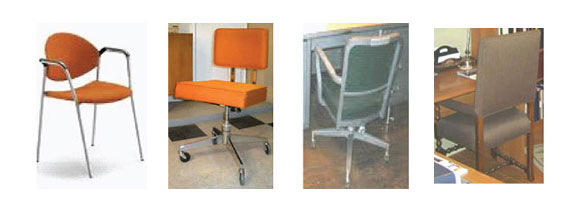
- Some examples of the type of office chairs that might be considered for replacement:
- What is the timeline?
- Applications:
- Grant proposals are accepted year round. Submit an application. Please note, we are experiencing some technical issues with our grant application. If you are having problems accessing or submitting your grant application, please print your application, and email MHealthy Ergonomics Awareness Team or fax a copy of the application to 734.764.0292. We apologize for this inconvenience and appreciate your patience.
- Reviews:
- Applications will be reviewed monthly, as long as funds are available. Some applications may be on hold for a month or more while additional information is requested or comparison continues regarding needs versus remaining funds.
- Review dates:
- Throughout the year until annual funds are exhausted
- Notifications:
- Notifications of committee decisions will follow the reviews, typically within a few weeks of the decision
- Requirements:
- Winners will be required to provide proof of purchase, a post-survey, and a digital photo showing the project in use.
- Who can apply for a grant?
- Any U-M faculty or staff member can submit an application. A department manager's signature of approval is required for the application to be funded.
- What if you applied in the past and were not funded? Can you reapply, and what are the chances of being funded?
- Yes, everyone can re-apply. The chances of being funded depend on the how your project compares with the other requests that the team receives, and the amount of funds available Contact your local ergonomics representative for specific questions.
- If the grant is approved, what will be required of our department?
-
- A manager's signature of acceptance is required on the MHealthy letter offering funds
- Your department fully purchases and installs the approved equipment
- Your department emails all of the required purchase documentation, a brief post-survey, and a digital photograph showing the reduced risk to MHealthy Ergonomics Awareness Team according to the timeline included in the MHealthy letter of offer. Failure to meet the timeline may jeopardize your department’s consideration for future grants.
- MHealthy completes the approved reimbursement via journal entry.
- MHealthy shares information about your success with U-M Leadership. See past projects.
- How do I apply?
- Prepare to apply by:
-
- Know who the manager and financial contact is in your department, names, phones, emails
- Be able to concisely describe the problem, the number and type of annual injuries or near-misses, solutions already tried and your proposed solution.
- Be specific regarding equipment desired. If unsure, before you apply, check with your local ergonomics representative for help identifying a solution. Their information can be found on the How to Get Help page.
- Provide a specific cost of the solution, your department’s maximum cost share, and the amount of money that you are requesting from MHealthy. Research costs to find your best price before applying.
- Take a digital photograph demonstrating the current problem, save it to your computer, and be ready to upload it to the online application.
- Complete the online application, including the required digital photo simulating the risk of injury.
-